
Transform Your Garden House into a Workshop

Converting a garden house into a workshop gives homeowners a practical, cost-effective way to expand usable space. Whether you want to convert garden shed to workshop for woodworking, create a garden studio conversion for crafts, or establish an outdoor workshop UK for small‑scale production, this guide explains the essentials.
This article is aimed at hobbyists, makers, woodworkers and small‑business owners seeking a dedicated garden workspace. We cover feasibility, legal checks, design for workflow, insulation and ventilation, electrics and lighting, security and storage, and the tools you will need.
Follow the step‑by‑step approach to assess your garden house, meet UK planning and Building Regulations, and select suitable materials from reputable suppliers like Wickes, Screwfix and B&Q. Practical tips on safety from the British Safety Council and dust‑extraction brands such as Festool and Bosch will help you build a safe, productive space.
Inhaltsverzeichnis
Key Takeaways
- Turning a garden house into a workshop can be a cost‑effective way to gain workspace without extending the main house.
- Early checks on permitted development rights and Building Regulations save time and cost.
- Good layout, insulation and ventilation are crucial for year‑round use and safety.
- Plan electrics and lighting with an accredited electrician to meet Part P requirements.
- Secure storage and sensible tool choices improve efficiency and protect your investment.
Benefits of Using a Garden House as a Workshop
Turning a garden house into a dedicated workspace brings a host of practical gains. Small businesses and hobbyists report better concentration when tools, materials and tasks remain in a single, purpose-built space. The benefits garden workshop extend beyond order; a tailored layout helps you work faster and with fewer mistakes.
Improved productivity and focus
A separate outbuilding reduces domestic interruptions and creates a clear boundary that supports longer blocks of deep work. Research in workplace psychology shows defined zones boost task completion and creativity. Lighting, acoustics and bench height can be set to suit specific tasks such as fine detail work, sanding or painting, which increases workshop productivity and reduces rework.
Separation of living and working spaces
Keeping noisy or dusty activities outside the house preserves domestic hygiene and lowers disturbance to family life. This home work separation helps establish mental limits between professional tasks and leisure time. For client meetings or stock storage, an outbuilding projects a professional image that the main house cannot match.
Cost-effective alternative to building an extension
Converting a garden house or installing a prefabricated garden room is often faster and less expensive than extending the main property. Savings come from lighter foundations and reduced structural work. Suppliers such as Hartley Garden Studios and Regent Garden Buildings offer insulated garden rooms suitable for year-round use, making the choice economical. Buyers should check planning rules, as permitted development rights can speed delivery when size and siting comply.
There are extra garden room advantages to consider. A well-appointed outbuilding can increase appeal to future buyers, remain flexible for conversion to a studio or guest room, and sometimes carry lower council tax or business rate implications than a full extension. Confirm local regulations to understand exact implications.
Planning and Permits for a Garden Workshop
Setting up a garden workshop requires more than tools and timber. Check rules early so the build avoids delays or enforcement action. Use clear records and seek formal advice when your plot sits in a conservation area or is listed.
https://www.youtube.com/watch?v=YHsrjzV3L4s
Understanding permitted development rights in the UK
Most small outbuildings fall under permitted development rights. Typical limits include single-storey only, maximum ridge heights that depend on distance from boundaries, and total ground area that must not exceed 50% of the property curtilage.
Check the Planning Portal and local authority pages for up-to-date guidance. Special rules apply to listed buildings and properties in conservation areas, where a permitted development garden room may not be allowed without extra approval.
When planning permission is required
Apply for planning permission when your proposal exceeds permitted dimensions or sits in a front garden where restrictions apply. Replacing existing outbuildings with larger structures often needs formal consent.
Local planning authorities handle cases with Article 4 directions or where neighbouring properties raise concerns about visual impact or overshadowing. If in doubt, request a pre-application meeting to reduce risk.
Building regulations and safety standards
Standalone workshops under certain sizes may escape full building regulation approval, yet specific elements still trigger rules. Electrical work must comply with Part P and should be certified by a competent installer.
Heating installations, structural alterations and fire-safety measures can bring your project under Building Regulations workshop requirements. Use registered professionals such as NICEIC, NAPIT or Gas Safe for relevant work and retain certificates.
Follow health and safety guidance for machinery guarding, COSHH for hazardous substances and Control of Noise at Work where applicable. Keep documentation of tests, certificates and any permissions for future sale or inspection.
Practical steps help compliance: obtain written confirmation from your local authority if unsure, keep electrical certificates safe, and consider a pre-application planning enquiry for larger conversions. Consulting conservation officers early will avoid costly redesigns.
Designing the Layout for Efficient Workflow
A clear plan turns a garden house into a productive workshop. Start with simple zoning, sketch mock-ups on graph paper or use free CAD tools. Visualising space helps check clearances for doors, tool operation and material handling.

Zoning: workbench, storage and machinery areas
Adopt a three-zone approach. Place the primary workbench area for hands-on tasks and fine assembly near good light and power. Set a storage zone for raw materials, consumables and spare parts with shelving and labelled containers for quick retrieval.
Locate the machinery and utility zone for larger equipment such as table saws, lathes and compressors. Keep clear sightlines between zones and safe walkways of 600–900 mm depending on equipment. Dedicate a locked cabinet or ventilated cupboard for hazardous materials.
Workflow considerations for different crafts
For woodworking, position dust-producing machines close to an exterior wall or window to ease extraction ducting. Run extraction in straight lines where possible to reduce blockage and noise.
Metalwork needs fireproof surfaces, good ventilation for fumes and a separate bench for grinding with a spark guard. Place a fire extinguisher and metal waste bin nearby.
Electronics and fine assembly demand ESD-safe surfaces, abundant task lighting and strict dust control. Keep small parts organised in compartment trays and reserve a clean bench area for sensitive work.
Draw multiple mock-up layouts to test movement of materials and trolleys. Simple plans expose pinch points and help size turning radii for moving stock.
Accessibility and ergonomics
Choose bench heights to suit tasks: general standing benches around 900 mm, seated or fine-assembly benches at 700–750 mm. Consider an ergonomic workbench with adjustable height to suit different users and jobs.
Use anti-fatigue matting where people stand for long periods. Keep frequently used tools and consumables within shoulder height to avoid overreaching. Provide clear labelling for faster retrieval and safe handling.
Design a safe entrance with level access or a small ramp to move heavy items in and out. Ensure aisle widths and turning circles accommodate trolleys and material carts without obstruction.
Insulation, Ventilation and Climate Control
Preparing a garden house for serious work means getting insulation, ventilation and heating right. Good fabric choices and sensible ventilation keep tools in top condition and protect your health. Small steps can cut running costs and make a garden room usable all year.

Choosing suitable insulation materials
For timber-built spaces, mineral wool such as glass wool or rock wool gives strong thermal and acoustic performance. Use PIR or XPS rigid boards where cavity depth is limited to avoid thermal bridging. Spray foam suits sealed applications but needs professional fitting to prevent gaps and vapour issues.
Fit a vapour barrier or a breathable membrane depending on wall construction. Reducing thermal bridges at studs, floor joists and around windows makes modest insulation far more effective. Aim for U-values close to those in habitable rooms when practical to reach true year-round comfort.
Heating options for year-round use
Electric convectors and oil-filled radiators provide quick, controllable warmth for small spaces. Infrared panels heat people and benches directly, making them efficient for intermittent use. Electric underfloor heating works well under resin or plywood floors for even warmth.
For larger workshops or off-grid setups, a wood-burning stove can give robust heat but needs a flue and compliance with Building Regulations. LPG or butane heaters are portable choices but must follow Gas Safe guidance. Better insulation lowers running costs and lets you choose a smaller, cheaper heater.
Use a programmable or smart thermostat to avoid wasted energy. Setbacks for non-working hours reduce bills while keeping the space frost-free for tools and finishes.
Effective ventilation and dust extraction
Ventilation protects health and extends equipment life. Passive vents provide continuous background airflow to cut condensation and mould risk. For tasks that produce fumes or solvent vapours install mechanical extract fans or a window-mounted extractor to boost air changes when needed.
For woodwork choose a dust extraction for small workshop use with appropriate filtration. Brands such as Festool, Bosch and Jet offer units with HEPA or M-class filters for fine dust control. Place local extraction at sanding and sawing stations and run sealed ductwork to a central unit where possible.
Match air changes per hour to the task: light assembly needs modest ventilation, painting and solvent work demand higher rates. Regularly clean filters and check seals to keep the system working efficiently and to protect both air quality and your investment.
Electrical Setup and Lighting for Safety and Precision
Good electrical design in a garden workshop keeps work safe and efficient. Decide on a power approach early so wiring and circuits match your tools and plans. Think about supply type, protection devices and layered lighting to suit fine work and heavy machinery.
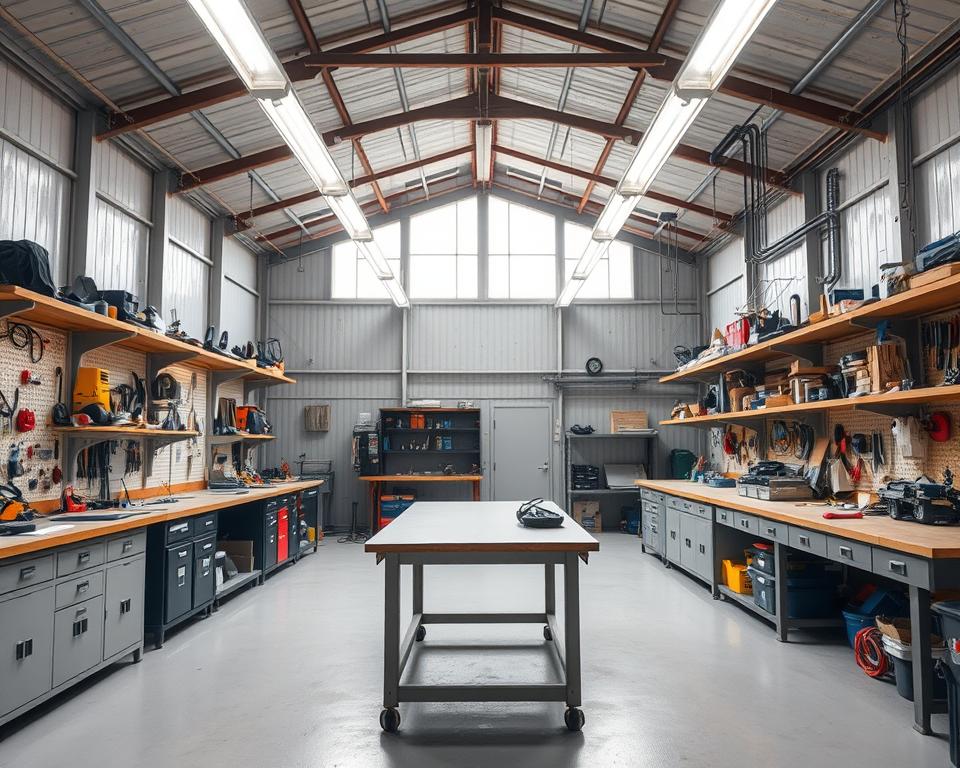
Power supply options range from a radial spur off the house consumer unit to a dedicated feeder and separate consumer unit in the outbuilding. For low-power users, off-grid solar with battery storage can work well. In every case, have a qualified electrician check meter capacity, cable size and placement; SWA armoured cable is common for buried runs in the UK.
Calculate expected load from motors, compressors, heaters and lighting. Use these figures to size protective devices and cable runs. Plan separate circuits for lighting, sockets and heavy machinery to reduce nuisance trips and to make isolation during maintenance straightforward.
RCD protection is a legal and practical necessity for socket circuits and portable tools. Fit RCDs for person protection and MCBs for short-circuit and overload protection. Ensure correct earthing and bonding for any incoming supply. All fixed work should be carried out by a competent person and certified under Part P or Building Regulations where applicable.
Choose lighting that supports precision. Use ambient LED panels or linear LED strips for even illumination. Add flexible task lamps, adjustable bench lights or swing-arm fittings over workbenches for close-up tasks. Aim for a high CRI (90+ preferred) where colour matching or fine detail is important.
Maximise natural daylight with north-facing windows for consistent illumination, plus rooflights or translucent panels to wash the workspace in soft light. Control glare with diffusers, matte finishes and well-placed blinds. In dusty or humid zones, select fittings with appropriate IP ratings to maintain safety and longevity.
Below is a practical comparison to help decide the right electrical and lighting approach for common workshop types in the UK.
| Workshop Type | Recommended Power Supply | Protection & Safety | Lighting Approach |
|---|---|---|---|
| Light hobby (hand tools, soldering) | Radial spur from house or small solar battery | Single RCD-protected socket circuit, MCB 16–20A | LED panels + task LED bench light (CRI 90+) |
| Medium use (table saw, compressor) | Dedicated supply with separate consumer unit | Separate circuits for sockets, machinery and lighting; RCD and MCBs | Linear LED strips, adjustable task lamps, rooflight for daylight |
| Heavy duty (multiple machines, heater) | Heavy-duty feeder with SWA cable and isolated consumer unit | Multiple RCD-protected circuits, Type B or C MCBs, full earthing/bonding | High-output LED panels, directed task lighting, diffuse skylights |
When planning any work, discuss garden workshop power supply UK options and RCD workshop requirements with a NICEIC or ECA-registered electrician. Good planning reduces risk and makes the workshop a safer, more productive place to create.
Security, Storage and Organisation
Protecting tools and keeping a tidy workspace matter for safety and productivity. A secure garden workshop starts with robust locks and smart placement of valuables. Good storage and clear tool organisation reduce theft risk and speed up every task.
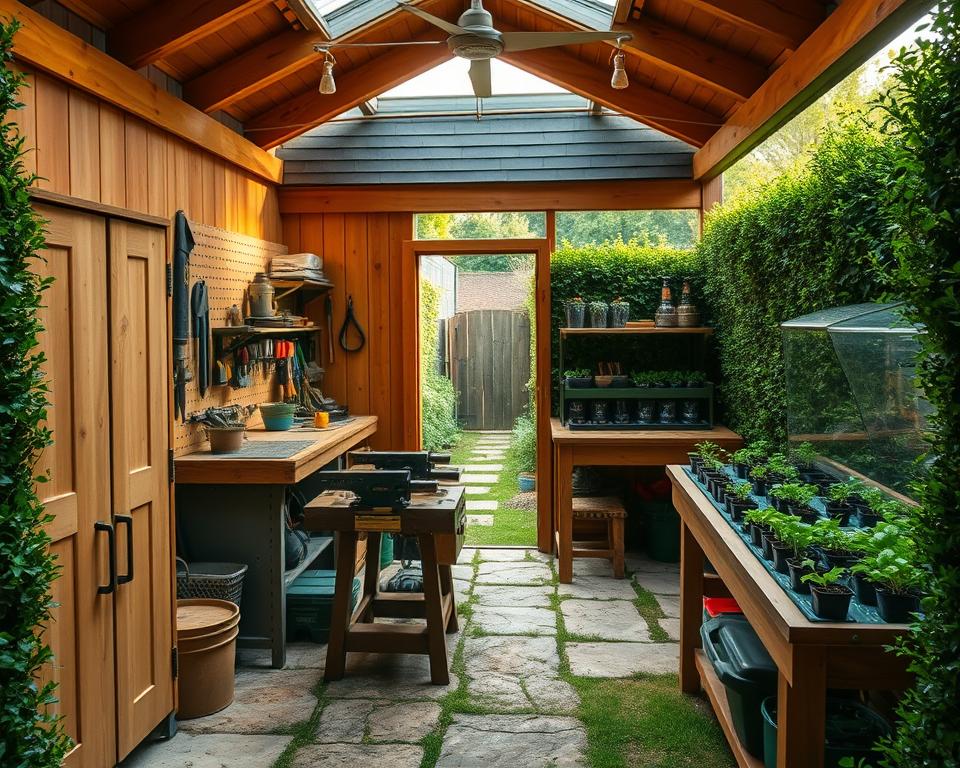
Securing doors, windows and valuables
Fit British Standard locks where possible, such as BS EN 12209-compliant mortice locks and strong security hinges. Use hasp and staple fittings with ground-fixed padlocks for external doors. Install window locks and consider simple alarm sensors from Yale or Ring for door and window alerts.
CCTV with cloud recording suits high-value kit. Secure heavy kit with chained, bolted-down anchor points and keep expensive items out of view when not in use. These steps raise shed security UK standards and deter opportunist thieves.
Smart storage solutions for tools and materials
Combine fixed shelving and mobile units for flexibility. Steel or galvanised shelving from Screwfix or Wickes handles timber and heavy boxes. Use clear plastic bins with labels for small parts and sealed cabinets for chemicals.
Store flammables in purpose-built cabinets that meet BS EN 14470-1 where required. Mobile tool trolleys and lockable cabinets give easy access while keeping items secure. These workshop storage solutions save space and protect stock.
Workbench organisation and pegboard systems
Choose a sturdy workbench with integrated vices and drawers to keep tools close. Fit a pegboard or steel perforated panel above the bench and use modular hooks and shadowboard outlines for rapid tool retrieval.
Add magnetic strips for drill bits, labelled drawers for fasteners and a parts organiser for small components. Adopt brief 5S-style routines — Sort, Set in order, Shine, Standardise, Sustain — to maintain order and strengthen tool organisation over time.
Tools, Equipment and Workshop Essentials
Outfitting a garden house for practical projects starts with a clear plan for tools, machinery and upkeep. Choose reliable items that suit the crafts you pursue. Think about space, noise control and routines that keep equipment working safely for years.
Choosing essential hand and power tools
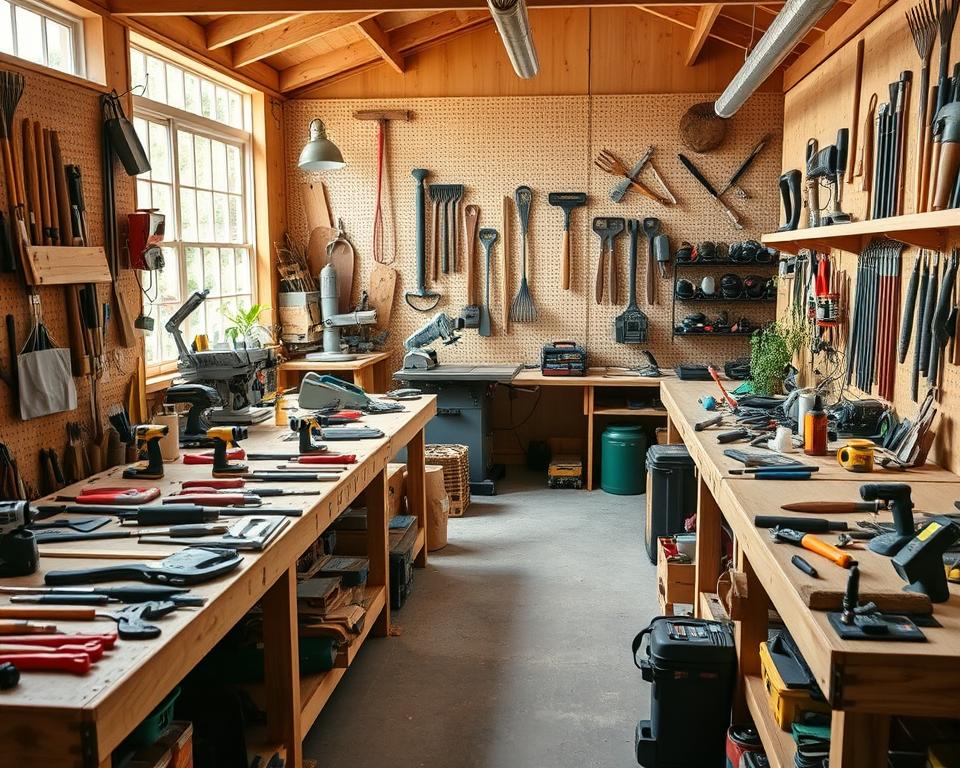
Stock a core kit of hand tools: claw hammer, chisels, screwdrivers, block plane, combination square and spirit level. Pick sturdy brands such as Stanley or Bahco for hand tools. For power tools, prioritise a cordless drill/driver, circular saw, jigsaw, random-orbit sander and a mitre saw for woodworking. Trusted manufacturers like DeWalt, Makita, Bosch and Festool offer models that balance performance and longevity. Quality over quantity pays off for frequently used items.
Selecting machinery with space and noise in mind
Evaluate footprint and clearance before buying larger machines such as table saws, bandsaws or lathes. Small workshop machinery in benchtop or compact multi-function formats can save space while keeping capability. Check noise levels and plan for acoustic mitigation when neighbours are close.
Use enclosures, acoustic panels and isolation mounts to cut airborne noise. Fit vibration-dampening pads under heavy gear to protect the structure and reduce transmission. These measures make it easier to run larger kit without disrupting the household or garden.
Maintenance routines to extend equipment life
Adopt a simple, regular care plan. Daily wipe-downs and dust removal prevent build-up around motors and switches. Weekly tasks include lubrication and tightness checks on blades and fasteners. Monthly checks should cover electrical leads, plugs and motor brushes. Arrange annual professional servicing for large machines to preserve safety and warranty.
Store blades and bits in labelled cases and apply rust-prevention oil to metal tools. Learn correct sharpening techniques for cutting edges to maintain performance. Keep a maintenance log and use manufacturer-authorised dealers for replacement parts. These tool maintenance tips will protect investment and ensure reliable results.
Decor, Comfort and Personalisation
Transforming a garden house into a useful workshop relies on practical decor and thoughtful comfort. Choices for floors, sound control and personal touches shape both function and atmosphere. Below are focused options to help you plan a durable, pleasant space that suits a variety of crafts and hobbies.
Flooring choices for durability and comfort
Vinyl sheet or vinyl tiles give a clean surface that resists chemicals and is simple to mop. They suit light to medium use and speed up maintenance routines.
Sealed and painted plywood or OSB keep initial costs low and let you upgrade later. A good sealant prevents moisture ingress and helps with levelling on uneven ground.
Rubber floor tiles and anti-fatigue mats reduce strain during long standing tasks. These options support a comfortable workshop design and improve safety with slip-resistant textures.
Concrete with an epoxy coating suits heavy-duty use and machine mounts. Prioritise damp-proof membranes and surface preparation for longevity.
Soundproofing and noise mitigation
Begin with acoustic mineral wool in stud walls to reduce airborne noise. Add resilient bars and a double lining of plasterboard or sturdy plywood to break direct sound paths.
Fit door seals and threshold strips to cut flanking noise. Acoustic foam panels near noisy machines help absorb reflections and reduce local noise levels.
Place loud equipment near an external wall and provide a dedicated acoustic ventilation route to balance airflow and sound control. Check local nuisance laws and plan noisy tasks at considerate hours to keep good relations with neighbours.
Personal touches: colour, shelving and display
Light greys or matt off-white boosts natural light and keeps the space bright. Use durable satin or eggshell paints where cleaning is frequent.
Combine open shelving for tools you use daily with closed cabinets to hide clutter. Pegboards display favourite tools and keep them within reach, improving workflow.
Add a small comfortable chair for breaks, a kettle or mini-fridge for convenience, and a compact wireless speaker for low-level background sound. A few plants soften the room and improve air quality while you decorate garden workshop with personality.
| Feature | Best for | Pros | Cons |
|---|---|---|---|
| Vinyl sheet / tiles | Light to medium workshops | Easy to clean, chemical resistant, smooth finish | Can dent under heavy loads, may need sound underlay |
| Sealed plywood / OSB | Budget builds and modular upgrades | Low cost, easy to repair, upgradeable | Requires good sealing against damp, less durable than concrete |
| Rubber tiles / anti-fatigue mats | Workshops with long standing tasks | Comfort underfoot, slip resistance, reduces fatigue | Can trap dirt at seams, may be pricier per m² |
| Concrete with epoxy | Heavy machinery and wash-down areas | Extremely durable, easy to level, hard-wearing | Cold and hard underfoot without mats, requires good preparation |
| Acoustic wall treatment | Noisy equipment zones | Reduces transmitted sound, improves concentration | Adds depth to walls, needs professional fitting for best results |
| Paint and shelving | All workshop types | Improves light, organisation and morale | Poor-quality paint shows marks; heavy shelving needs good fixings |
Conclusion
Converting a garden house to workshop is a rewarding project that starts with clear assessment and planning. First, check permitted development rights and any planning requirements, then draft a compact floor plan that zones a workbench, storage and machinery areas for smooth workflow and good ergonomics.
Next, prioritise insulation, ventilation and safe electrics with certified contractors such as NICEIC or NAPIT registrants. Fit task lighting and dust extraction suited to your craft, secure doors and windows, and install smart storage to keep tools organised. Regular maintenance will extend the life of equipment and protect your investment.
Use this garden workspace summary as a practical roadmap. Follow the garden workshop checklist: confirm planning status with the Planning Portal or local authority; produce a detailed tool and equipment list; obtain quotes from accredited electricians and builders; choose heating, ventilation and insulation to match use; plan security and storage; schedule certified installation and testing; and set up health and safety and maintenance routines.
Keep records of electrical certificates and any Building Regulations compliance, consult accredited professionals for structural or gas work, and consult HSE guidance on dust and COSHH for chemicals. Start with basic functional elements and add machinery, extraction and finishing touches gradually as budget and needs evolve.
FAQ
Can I use my garden house as a workshop without planning permission?
It is often possible to use a garden house as a workshop under permitted development rights, provided the building meets the size, height and siting limits set out by the Planning Portal. Restrictions apply for listed buildings, conservation areas or if the outbuilding exceeds the permitted footprint (generally not exceeding 50% of the property curtilage). When in doubt, contact your local planning authority or submit a pre-application enquiry for clarity.
Which Building Regulations apply when converting a garden room into a workshop?
Standalone garden workshops do not always require full Building Regulations approval, but specific elements are regulated. Electrical installations must comply with Part P or be installed and certified by a competent person (NAPIT or NICEIC). Structural alterations, heating appliances and means of escape considerations may trigger Building Regulations. Retain certificates for any regulated work and consult an accredited tradesperson for guidance.
How should I plan the layout for efficient workflow in a small garden workshop?
Use a three-zone approach: a primary workbench area for hands-on tasks, a storage zone for raw materials and consumables, and a machinery/utility zone for larger equipment. Ensure safe walkways (600–900 mm where needed), clear sightlines between zones and dedicated space for hazardous materials. Mock up layouts on graph paper or simple CAD tools to verify clearances and tool placement before fitting out.
What insulation materials are best for a timber garden house intended as a year‑round workshop?
Common choices for timber structures include mineral wool (glass or rock wool) for thermal and acoustic performance, PIR/XPS rigid boards where cavity depth is limited, and closed-cell spray foam for airtightness. Use a suitable vapour control layer or breathable membrane depending on the build-up to avoid condensation and reduce thermal bridging. Aim for U-values closer to habitable rooms where practical to cut heating costs.
Which heating options are suitable and safe for a garden workshop in the UK?
Electric convectors, oil-filled radiators and infrared panel heaters are practical for small, well-insulated workshops. For larger spaces consider electric underfloor heating or, with proper flue and Building Regulation compliance, a wood-burning stove. LPG or gas heaters require Gas Safe-certified installation. A well-insulated workshop reduces heat demand and running costs, so pair heating choice with good insulation and programmable thermostats.
What ventilation and dust extraction do I need for woodworking or metalwork?
For woodworking, install a dedicated dust extractor with appropriate filtration (M-class or HEPA for fine dust) and position local extraction at sanding and sawing stations. For metalwork and tasks producing fumes, provide mechanical extraction or window-mounted extractors to achieve adequate air changes. Continuous background ventilation via passive vents helps control condensation and maintain air quality.
How should I size and install the electrical supply for workshop machinery?
Calculate combined load from motors, compressors, heaters and lighting and discuss results with a qualified electrician. Options include a radial spur from the house consumer unit, a separate consumer unit in the outbuilding with its own supply cable, or off-grid solar/battery for low-power setups. Use appropriate cable types (SWA for buried runs), proper circuit segregation and RCD protection to meet safety standards.
What safety devices and protections are essential for workshop electrics?
Install RCDs for socket circuits and portable tools, MCBs for circuit protection, and ensure correct earthing and bonding. Separate circuits for lighting, sockets and heavy machinery reduce nuisance tripping and ease isolation. Have all fixed electrical work carried out or certified by a competent person and keep documentation for Building Regulations compliance when required.
How can I secure my garden workshop against theft and vandalism?
Fit British Standard locks, security hinges, and consider ground-fixed hasps with quality padlocks. Use alarm sensors linked to a smart system (Yale, Ring) and CCTV with cloud storage for high-value equipment. Bolt down heavy machines to anchor points and keep valuables out of sight. For additional deterrence, use external lighting and neighbour notifications when noisy work is scheduled.
What are the best storage solutions to keep tools organised and safe?
Combine fixed heavy-duty shelving (Screwfix, Wickes) for bulk materials with mobile tool trolleys and modular cabinets. Use pegboards or steel shadowboards for visible tool organisation, labelled plastic bins for small parts and flammable storage cabinets for hazardous liquids. Adopt simple 5S routines to maintain order and safety in daily use.
Which essential tools should I prioritise when setting up a general-purpose workshop?
Start with quality hand tools—claw hammer, chisels, combination square, measuring tools—and reliable power tools such as a cordless drill/driver, circular saw, jigsaw and random-orbit sander. For regular woodworking, consider a mitre saw and a good dust extraction system. Invest in reputable brands like DeWalt, Makita, Bosch or Festool for durability and service support.
How do I manage noise and vibration to avoid disturbing neighbours?
Choose compact or benchtop machines where possible, fit isolation mounts and anti-vibration pads, and add acoustic insulation (mineral wool, resilient bars) to walls and ceilings. Position noisy equipment near external walls with acoustic ventilation solutions and schedule loud work considerately. For persistent issues, consult local noise nuisance guidance to ensure compliance.
What flooring should I use to balance durability, comfort and cost?
Vinyl sheet or tiles offer chemical resistance and easy cleaning. Rubber or anti-fatigue tiles improve standing comfort. For heavy-duty use, sealed concrete with epoxy coating provides durability. Budget options include sealed plywood or OSB with later upgrade potential. Prioritise slip resistance and consider a level, damp-proof subfloor before finishing.
Are there legal requirements for storing hazardous substances in a garden workshop?
Hazardous substances are subject to Control of Substances Hazardous to Health (COSHH) guidance. Store flammable liquids in purpose-built flammable cabinets and keep material safety data sheets (MSDS) for all chemicals. Label containers clearly and follow disposal and storage limits. For commercial activities, check local authority rules on storage quantities and licensing.
How often should I maintain workshop tools and machinery?
Adopt a simple schedule: daily clean-down and dust removal, weekly lubrication and blade checks, monthly electrical lead and motor inspections, and annual professional servicing for larger machines. Keep a maintenance log, use manufacturer-recommended consumables and source parts from authorised dealers to preserve warranties and performance.
Can I run a small business from a garden workshop and what about business rates?
Many small businesses operate from garden workshops, but you must check planning and business-rate implications. Occasional commercial activity is often acceptable, but regular customer visits, signage or significant structural change could require permission. Business rates depend on turnover, premises classification and local authority rules—verify with your council and HMRC for tax guidance.
What steps should I take before hiring electricians or builders for the conversion?
Obtain quotes from accredited tradespeople (NICEIC or NAPIT for electricians; Gas Safe for gas work), check references and review insurance and warranty terms. Request written scope of works, timelines and confirmation of compliance with Building Regulations where applicable. Keep certificates for electrical and regulated installations as part of your project records.
Which brands are recommended for dust extraction and workshop ventilation?
Reliable dust extraction and ventilation brands used in UK workshops include Festool, Bosch and Jet for extraction units and filters. Choose extractors with appropriate classification (M or H where needed) and ensure ducting and local extraction points match your tooling layout for effective dust control.
How can I improve light and colour accuracy for fine assembly or finishing work?
Use layered lighting: high-CRI (90+) LED ambient fixtures combined with adjustable task lights or bench-mounted lamps. Maximise diffuse natural light via north-facing windows, rooflights or translucent panels to avoid harsh shadows. Use matte surfaces and diffusers to reduce glare and ensure colour-critical tasks are done under consistent, high-CRI illumination.
Are there grants or incentives for energy-efficient upgrades to outbuildings in the UK?
Grants for domestic outbuilding upgrades are limited but schemes and incentives for energy efficiency may be available through local authorities or national programmes from time to time. Check government and local council websites for current offers on insulation, renewable energy installations or low-carbon heating. For business use, explore tax allowances such as Annual Investment Allowance for qualifying equipment.

