What garden style categories exist?
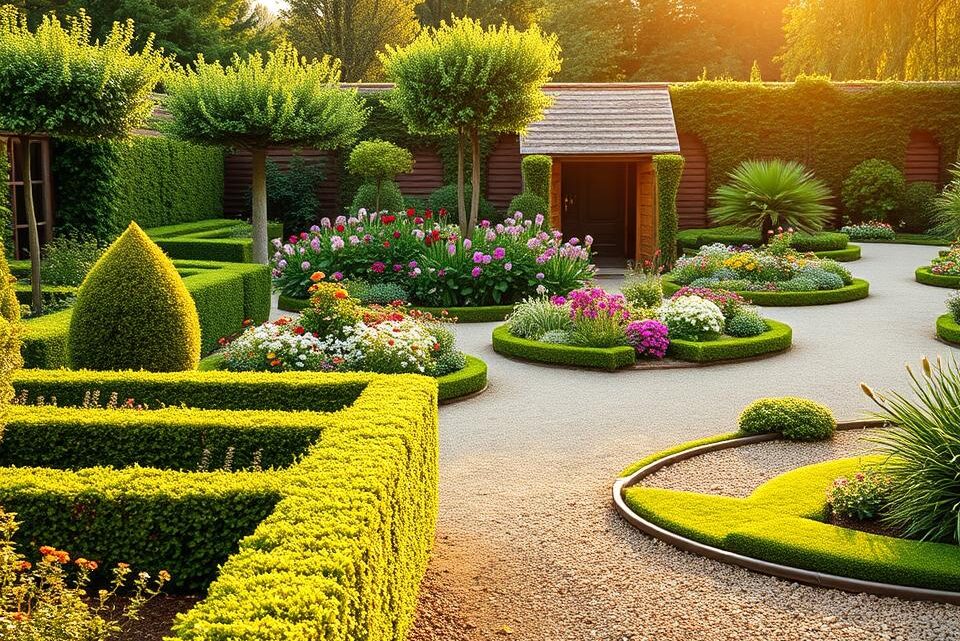
Choosing a guiding approach turns a confusing list of options into a clear brief you can follow.
A good approach can be summed up in a single word, feeling or philosophy. This focus helps you pick plants, paving and furniture that work together.
You can choose classic types — from cottage and formal to Mediterranean or Japanese — or pick a route based on site conditions, such as prairie, woodland or courtyard settings.
Mixing both routes often works well. For example, a small paved courtyard with a cottage feel keeps charm while fitting tight UK plots. The aim is to make design choices easier and to match maintenance, budget and water needs.
Inhaltsverzeichnis
Key Takeaways
- Pick a single guiding approach to simplify plant and hard landscaping choices.
- Compare classic types with condition-led routes to find what suits your plot.
- Mix compatible influences, such as cottage touches on a courtyard, for personality.
- A clear approach aligns design, maintenance and budget priorities.
- Shortlist a few options and map them to your site before detailed planning.
Understanding garden styles today in the UK
Assessing sun, soil and how you use the outdoor space helps you pick a practical approach that suits UK conditions.
Begin by mapping your plot and microclimate. Note shade, exposure and drainage so you choose a design that thrives rather than fights the site.
How to match style to your space, climate and lifestyle
Decide how much time you will spend on upkeep. If you are time-poor, favour controlled planting or naturalistic ideas over high-maintenance beds.
- Assess space and exposure — size, sun and soil steer plant and material choices.
- Match maintenance — align planting intensity with your weekly routine.
- Pick a dominant approach and borrow a few cues to avoid a muddled result.
Key elements that define a style: plants, structure, materials and mood
Styles are shaped by four simple elements: the plants you choose, the structural bones, the materials and the overall mood you want to create.
For example, a modern garden uses clean geometry and corten or gabions, mediterranean gardens favour drought-tolerant planting and gravel mulches, while a japanese garden relies on pruned specimens, stones and meaningful empty space.
Use these tips to create a short brief listing preferred styles, required elements and your maintenance tolerance. That brief becomes your practical source of inspiration when you start detailed garden design.
What garden style categories exist?
Map classic families against condition-led routes to find an approach that suits your plot, budget and weekly routine. This side-by-side view saves time and keeps choices focused.
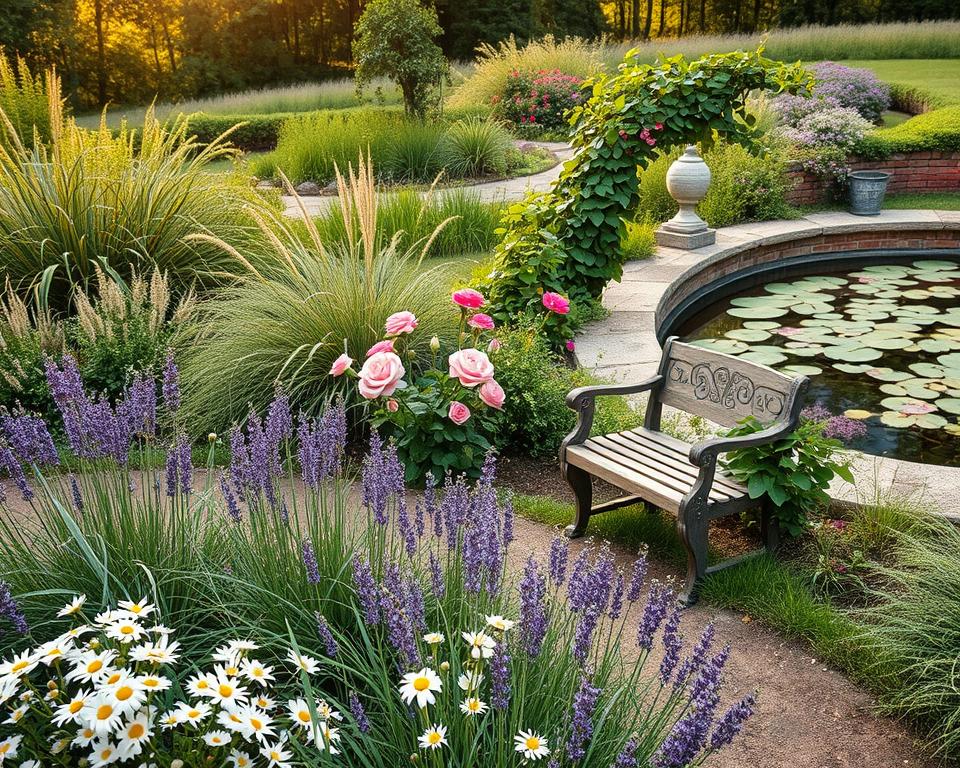
Classic families and when they fit
The familiar families include cottage, traditional/formal, English country, contemporary/modern, Mediterranean, coastal, exotic and Japanese. Each has a signature plant palette and material feel.
Condition-led and theme approaches
Practical routes cover prairie/naturalistic, woodland, rock/alpine, eco-friendly and edible potager or courtyard schemes. These respond to soil, sun, wind and water rather than pure aesthetic rules.
- Tip: pick one dominant approach and borrow two or three consistent cues to avoid a muddled result.
- Blends work well: a cottage courtyard can keep charm while fitting a small urban plot.
-
“Choose plants that suit the site, then build the design around them.”
Cottage garden style: relaxed abundance and year-round charm
Think of your plot as a layered tapestry. A cottage garden thrives on generous mixes of roses, perennials and climbers that give colour and texture through the year. This plant-led approach blends edible and ornamental planting so the space feels both useful and abundant.
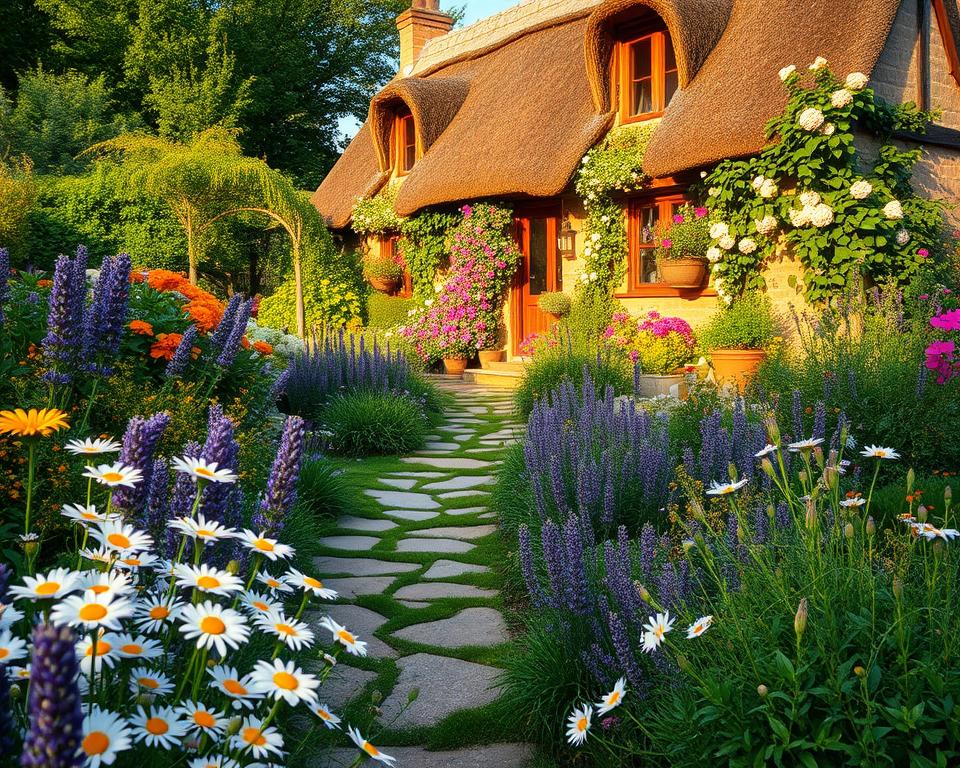
Signature planting: roses, perennials, climbers and herbs
Build around repeats: roses and long-lived perennials form the backbone, with seasonal bulbs and self-seeders filling gaps. Add herbs and a fruit tree or two to weave edible threads through the beds.
Paths, seating and a no-lawn look for small gardens
In small gardens, swap formal turf for winding paths and dense planting. Keep paths narrow so plants can brush past, and place simple seats or benches as restful perches for tea and reading.
Budget-friendly ideas and seasonal colour
Use practical tips: divide perennials, swap seeds and reuse pots. Let strong self-seeders knit borders and choose local plants that thrive in your region.
- Succession planting: bulbs in spring, perennials in summer, seedheads in autumn and evergreens for winter structure.
- Maintenance: stake tall plants once, deadhead to encourage repeats and mulch annually to cut weeding.
“Let personality show in collected pots and informal arbors rather than matched sets.”
Traditional, formal and English country garden styles explained
Traditional and formal approaches rely on clear geometry and a sequence of rooms to give a measured, classical feel. You use structure first, then layer planting for colour and movement. This helps you balance upkeep with visual impact.
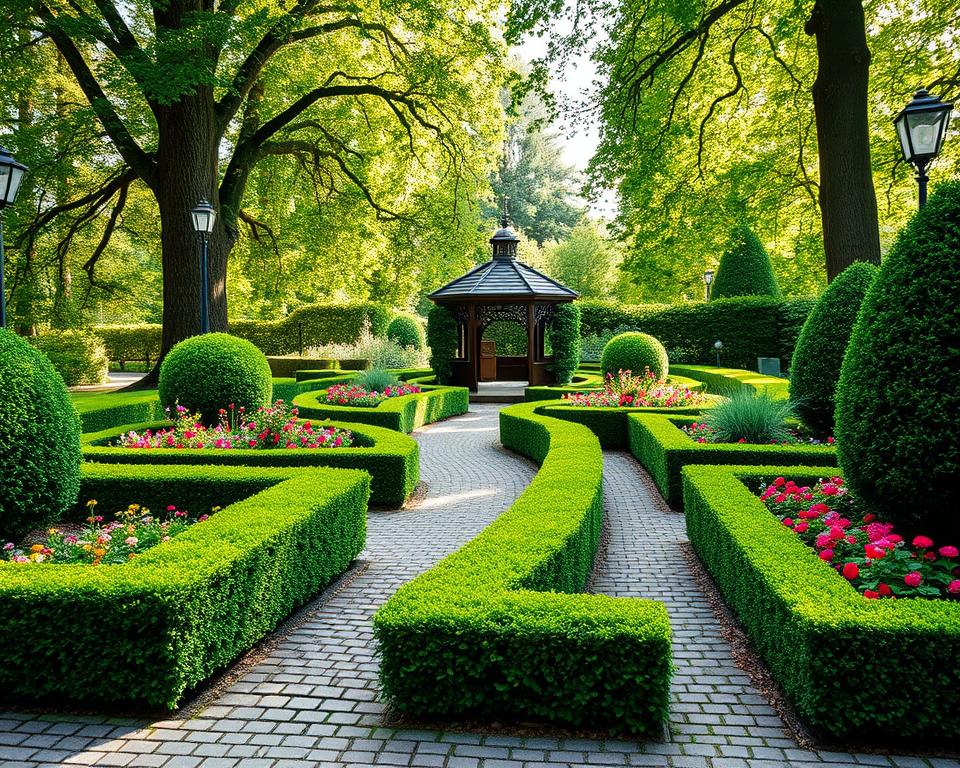
Formal geometry: parterres, topiary and framed focal points
Formal geometry is visible in parterres, knot beds and aligned topiary. You place focal points—urns, sundials or a single statue—at the end of an axial view to anchor a vista.
Traditional borders and lawns with garden rooms
You divide space into “garden rooms” using hedges, walls or trellis so practical areas sit apart from flower beds.
Lawns are kept proportionate and crisp to give breathing space between planted areas and to reduce a sense of clutter.
English country elements: deep herbaceous borders and wide paths
English country planting blends formal bones with rich herbaceous borders. Perennials and seasonal flowers are layered with shrubs for winter presence.
Wide paths encourage generous circulation and create a relaxed flow. Add traditional furniture, roses and urns to hint at cottage charm without losing the disciplined design.
- Use hedges to frame rooms and set rhythm.
- Choose materials—brick, gravel, stone—that match your house.
- Maintain edges, clip seasonally and mulch annually to keep lines clear.
| Feature | Formal | Traditional | English country |
|---|---|---|---|
| Layout | Geometric parterres and axes | Structured beds and lawns | Formal rooms with soft borders |
| Planting | Clipped topiary, restrained palette | Planned colour schemes, lawns | Deep herbaceous borders, mixed shrubs |
| Materials | Stone and trimmed gravel | Brick, paving and terracing | Brick, gravel paths and timber trellis |
| Circulation | Aligned paths for sightlines | Defined paths and terraces | Wide paths for two abreast |
Contemporary and modern gardens: clean lines and controlled planting
Contemporary schemes favour deliberate geometry and carefully chosen materials to make small plots feel calm and ordered. This approach uses strong axes, simple shapes and repeated elements so every feature counts.
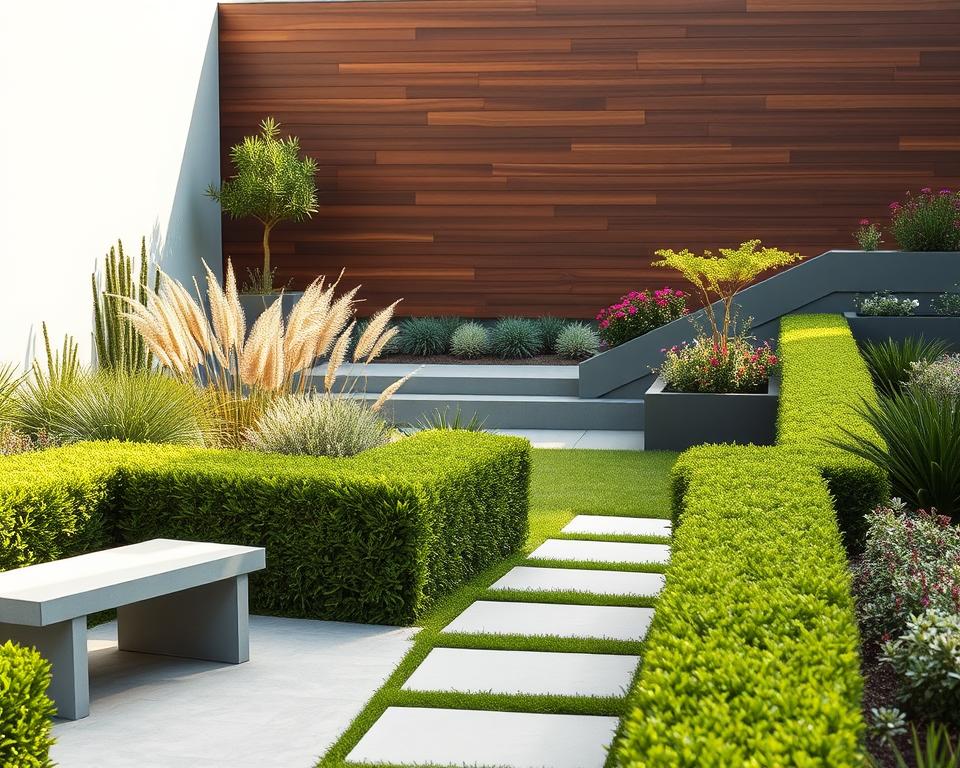
Materials to consider: corten steel, gabions, stone and gravel
Choose robust materials such as corten steel, gabions, honed stone and gravel. Repeat one or two materials to avoid visual noise and to give cohesion to landscaping and furniture.
Plant palettes with architectural forms and restrained colour
Limit your plants to around 12–20 species. Use architectural specimens: clipped forms, structural grasses and bold foliage in a restrained palette of greens, whites and one accent hue.
Design moves that make small gardens feel bigger
Use repetition, open sightlines and large-format paving to expand perceived scale. Raise boundaries with trellis, tuck storage into benches and keep furniture low and linear for continuity.
- Prioritise clear geometry—rectangles, grids and axes—for visual clarity.
- Integrate a linear rill or subtle water feature to echo the lines.
- Use lighting and evergreen structure for year‑round legibility and evening use.
“Show gardens prove that a limited palette and clever scale can make a small plot feel generous.”
| Feature | Materials | Plant approach | Space-making |
|---|---|---|---|
| Look | Corten, gabions, honed stone | 12–20 species; clipped and architectural | Repetition, open sightlines, large slabs |
| Maintenance | Durable, low-fade finishes | Fewer species, grouped planting | Fold storage into seating; simple edges |
| Use in small gardens | Repeat one or two materials | Restrained colours; bold foliage | Trellis, linear rills, scaled furniture |
Japanese garden style: balance, form and texture
A japanese garden pares the scene back so each feature can be seen and felt. You aim for quiet composition, where texture and patina matter more than bright colour.
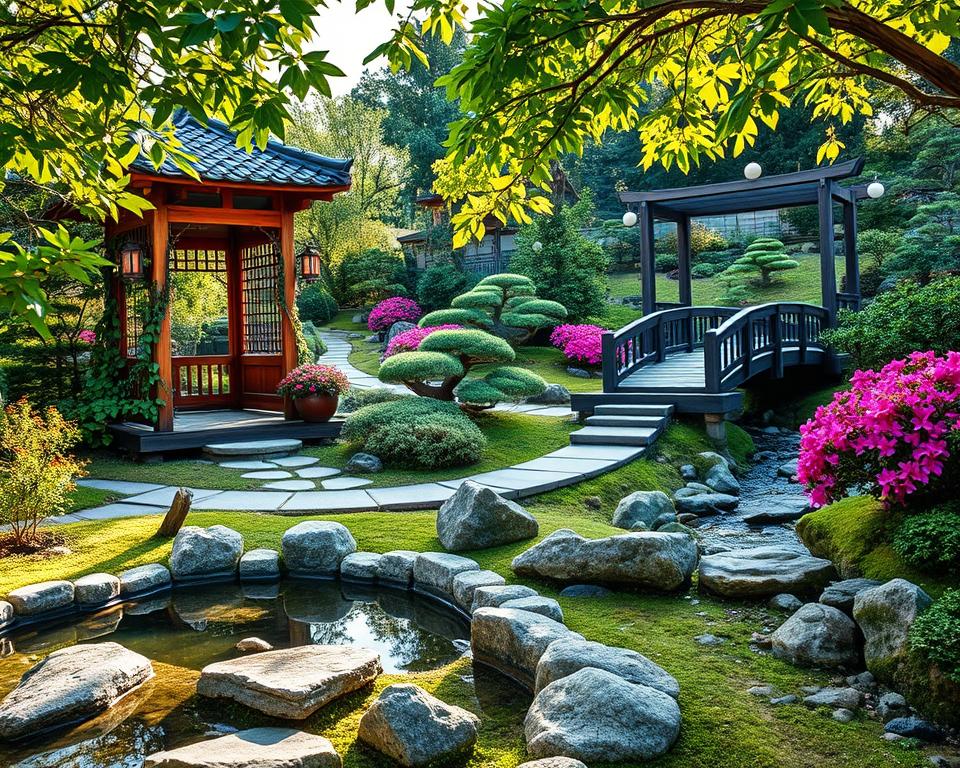
Pruned specimens, stone and moss
Give each pruned specimen space and use stone groupings to anchor views. Moss and low groundcovers knit hard and soft edges together and reward close inspection.
Water, ikebana and plant relationships
Use the ikebana idea—tall, mid and low plant relationships—to structure your planting. Balance still or moving water so the pond or stream reads as an integrated element.
Materials, paths and rock placement
Let materials age gracefully; welcome lichens and patina while keeping paths safe. Arrange rock and gravel with care to follow the terrain and avoid clutter.
- Choose fine-textured plants: acers, pines, ferns.
- Keep paths subtle—stepping stones protect sightlines.
- Refine skills: cloud pruning and tidy negative space.
“Restraint lets each element speak—one stone, one tree, one view.”
Mediterranean and dry gardens for lower rainfall areas
Focus on free‑draining soil, sculptural pots and hardy herbs to craft a sun‑baked retreat.
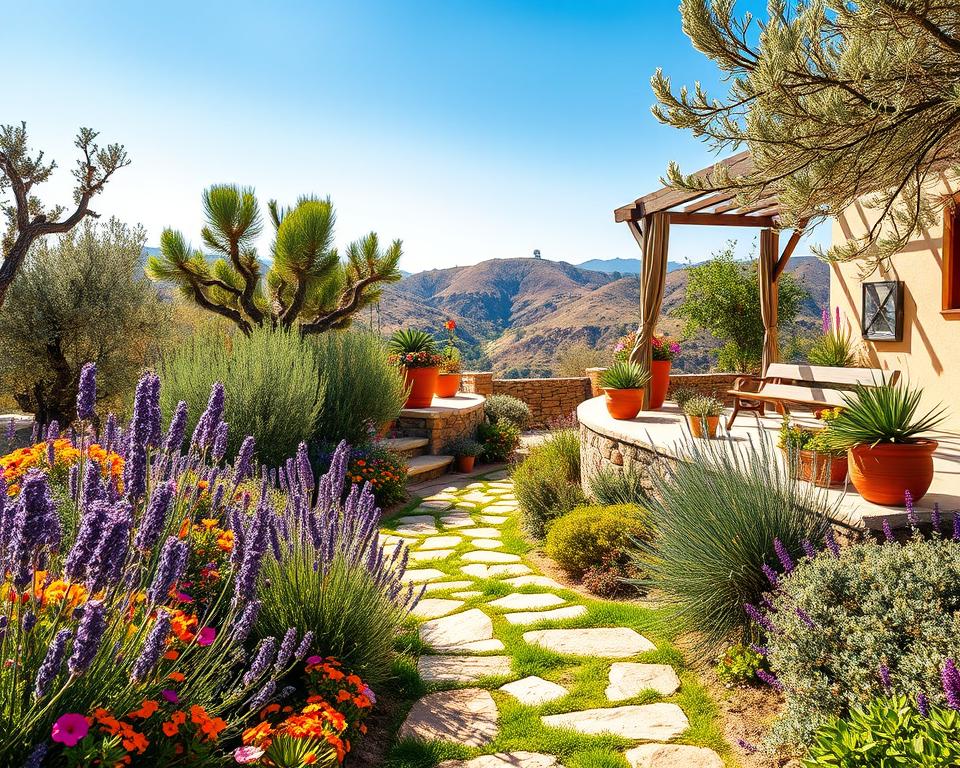
Drought‑resilient herbs and perennials
Choose rosemary, lavender, verbascum and ornamental grasses for long season interest and low thirst. Add succulents and small cacti where frost risk is low.
Group plants by water needs so younger specimens get extra moisture while established zones remain dry.
Gravel, pots and minimal lawns
Replace thirsty turf with deep gravel mulch and resilient groundcover to cut mowing and irrigation. Use pots for height and sculptural focus without increasing water demand.
UK reality check and practical tips
Beth Chatto’s approach sums it up: right plant, right place. In wetter parts of the UK, borrow the mediterranean garden look rather than trying a full dry scheme.
“Aim for free‑draining soil and warm hardscape tones to make the space read as sun‑baked.”
- Prepare free‑draining soil and slope beds to avoid sitting water.
- Use deep gravel and hand‑weed regularly; avoid thin membranes.
- Place seating in sunny, breezy spots and add shade sails sparingly.
Gravel gardens: water-wise, low maintenance impact
A well‑designed gravel bed reduces evaporation and encourages tough perennials to seed through. It replaces traditional borders and lawns by letting drought‑tolerant plants sit in deep, free‑draining ballast. Beth Chatto’s gravel plot in Essex is a good example of a scheme that needs no summer watering once settled.

Soil preparation, self-seeding and weed control
Choose an open, free‑draining spot and test sun and drainage before committing. Strip overly fertile topsoil where required so roots seek depth rather than sit in damp humus.
Plant at wide spacings with drought‑tolerant species and let self‑seeding fill gaps into natural mosaics. Use gravel depth and grading to keep crowns dry through winter and to suppress many weeds.
- Avoid membranes: they limit future planting flexibility; hand‑weed little and often instead.
- Layer textures: mix fine and coarse gravel to frame bolder plants and show form.
- Maintenance: spot‑water only new plants; leave seedheads for winter interest and wildlife.
- Finish: add subtle edging and simple timber or boulders so landscaping feels understated and tidy.
Coastal garden style: wind-hardy planting and seaside character
Seaside sites need pragmatic planting and material choices to withstand spray and gusts. Design for exposure and free drainage so planting can settle and thrive without fuss.

Planting into sand, shingle and gravel
Choose salt- and wind-tolerant plants and shrubs, grouping them so the toughest face the sea. Planting pockets work well in deep sand or shingle with a touch of organic matter to help establishment.
- Avoid lawns: favour gravel and hardy groundcovers that cope with dry, breezy conditions.
- Shelter: add permeable windbreaks—post-and-rail or clipped hedging—to diffuse strong gusts.
- Materials: use stone, timber and driftwood finds to echo the shore and resist wear.
- Microclimates: build low mounds and rock groupings to create sheltered pockets for less hardy plants.
- Water: capture rainfall in butts for early watering, then expect established plants to fend for themselves.
Keep furniture simple and durable; let natural weathering add character rather than fight it. Top up sand and gravel annually and prune seasonally to keep planting pockets tidy.
“Take plant lists from nearby seaside towns for local inspiration and proven success.”
Exotic or jungle gardens: layered foliage and bold colour
Dense, layered planting can make a small plot read as a tropical retreat even in cooler UK corners. Use large-leaved perennials, tree ferns and bananas to build drama without overcomplication.

Creating lush canopies in temperate UK climates
Build a canopy, mid-storey and ground layer with hardy exotics and architectural foliage. Add shrubs for backbone and winter presence beneath lush summer leaves.
- Choose bold flowers and foliage accents—cannas, dahlias and phormium—to punctuate green masses.
- Plan shelter and humidity with fences, evergreens and a greenhouse for tender plants.
- Stage pots of tender showpieces so you can move them to cover in cold snaps.
- Use small pools or bowls for reflection, but keep water use sparing to limit maintenance.
- Feed soils generously with compost and mulch, and thin vigorously each year to keep paths and views open.
“Think canopy first, then place the dramatic leaves so routes feel immersive.”
Naturalistic and prairie planting: grasses and late-flowering perennials
Prairie and naturalistic planting pairs flowing grasses with late perennials to give long season movement and wildlife value. This approach favours blocks and repeated drifts so the overall composition reads as a living tapestry rather than many small bits.

Combine matrix grasses with drifts of perennials to create rhythm and habitat. Plant in coherent blocks and repeat groups to build a steady pulse across the landscape.
Leave seedheads and stems through winter. These give structure, food for birds and striking silhouettes until spring. Choose UK‑suitable plants that cope with your soil and rainfall rather than only continental choices.
- Direct paths through planting to invite exploration without breaking flow.
- Simplify maintenance: an annual cut‑back, mulch and occasional editing of spreaders.
- Establish on weedy ground with smothering, soil prep and dense initial planting.
“Let the matrix of grasses do the heavy lifting; let the perennials be the punctuation.”
Scale design moves from public precedent to domestic plots: use formal edges for a neat/wild balance and plan succession from early grasses to late perennials for long seasonal interest.
Woodland gardens and shaded borders: serenity under the canopy
Turn dappled shade into an asset by grouping plants that relish low light and organic soils.

Read the shade patterns first — dry shade beneath mature roots feels different to cool, moist shade beside walls. Enrich often-dry soil with well‑rotted leaf mould or compost to mimic woodland litter.
Underplant with shade‑loving perennials and spring bulbs for layered interest. Add shrubs sparingly to keep light levels calm and to give winter structure.
Keep paths soft and curving to preserve a tranquil pace through the planting. Choose resilient groundcovers to suppress weeds in difficult dry shade and to reduce maintenance.
- Plant in pockets to avoid damaging roots and water well while young.
- Mulch generously in spring and replenish annually to conserve moisture.
- Prune lightly so dappled light reaches the understorey without losing enclosure.
| Condition | Best approach | Soil aid |
|---|---|---|
| Dry shade under trees | Resilient groundcovers and bulbs | Leaf mould and deep mulch |
| Cool, moist shade by walls | Moisture‑loving perennials | Compost and well‑draining topsoil |
| Semi‑open canopy | Layered planting with small shrubs | Annual mulch and spot watering |
“Plan seasonal highlights so serenity never lapses into monotony.”
Rock, mountain and alpine gardens: structure, stone and resilience
Arrange stone as if it were geology at work, then tuck compact, seasonally active plants into crevices.
Start with the bones: place boulders, ledges and scree to build believable outcrops. Siting is crucial — slopes must shed water so crowns stay dry through wet UK winters.
Use free‑draining substrates and sharpen soil mixes with grit for longevity. Repeat materials and colours so the look reads as a single rocky outcrop rather than scattered rubble.
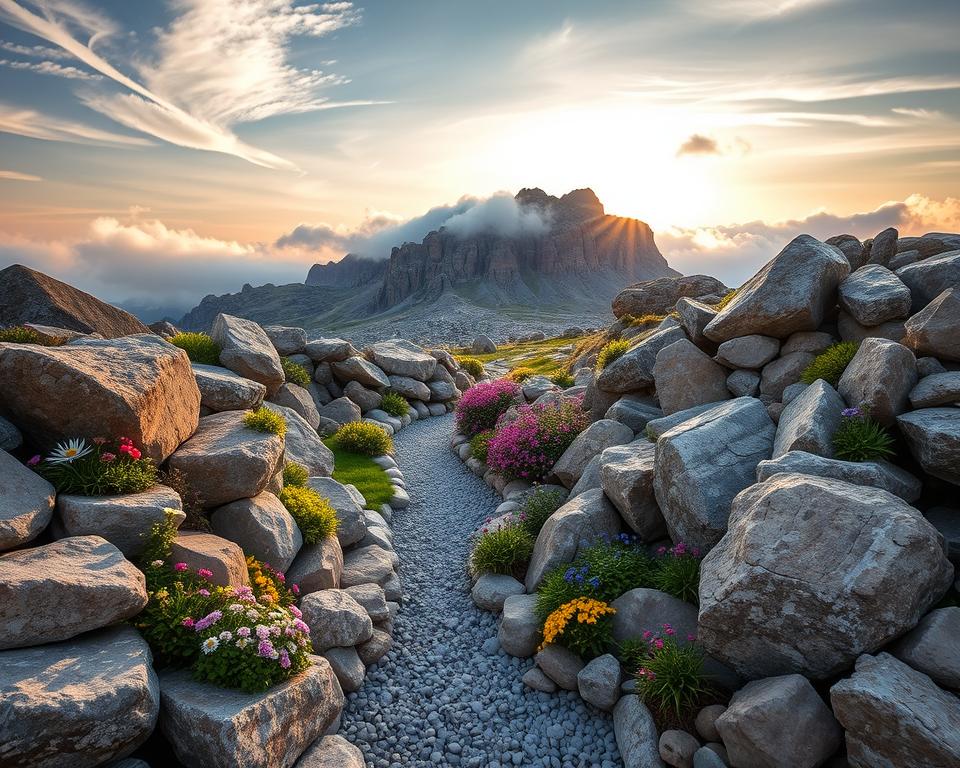
- Set boulders and stone first, then add planting pockets and scree.
- Craft crevices and slopes that drain fast and protect crowns.
- Choose compact plants bred for alpine conditions and thin soils.
“Balance rock mass and planting so neither overwhelms the other.”
| Feature | Approach | Benefit |
|---|---|---|
| Bones | Boulders, ledges, scree | Believable geology and shelter for plants |
| Soil | Sharp mix with grit and free drainage | Winter‑dry crowns and long‑term health |
| Planting | Compact alpines, troughs, cushions | Low maintenance and seasonal detail |
| Scale | Trough to full slope | Fits plots large and small |
Keep maintenance light: occasional weeding, top‑dressing and a tidy after flowering is usually enough. Use landscaping finesse to make man‑made outcrops feel natural and believable.
Bog gardens and waterside planting: thriving in wet spots
Turn your poorest draining patch into a showpiece with moisture‑loving planting and natural elements. Permanently boggy or poorly drained areas suit plants that relish saturated soil, and a designed bog at a pond edge becomes a wildlife magnet.
Define clear zones: standing water, saturated bog and drier margins. Match species to each band so roots sit where they prefer and you avoid moving plants later.
Use liners or harness capillary action to hold moisture where you need it. Plant densely to stabilise banks, suppress weeds and reduce long‑term maintenance.
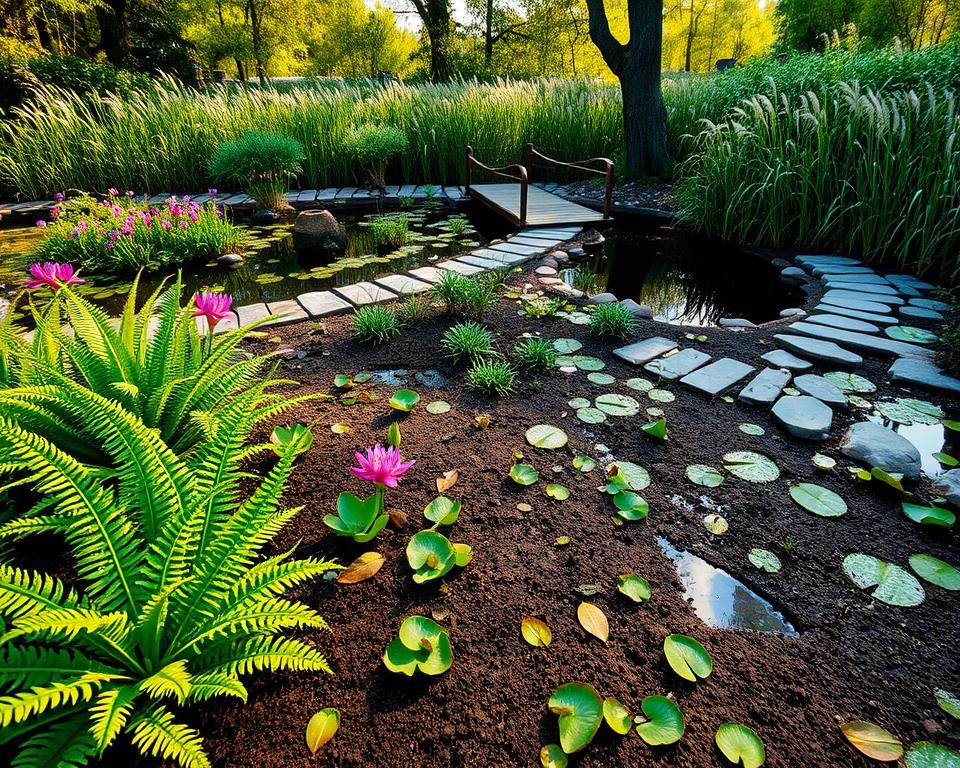
- Include stepping stones or a boardwalk to protect soil and give year‑round access.
- Plan overflow routes so heavy rain doesn’t flood terraces or beds.
- Provide small ponds with oxygenators and marginal plants to boost wildlife value.
“Embrace the wettest corner and you’ll cut irrigation elsewhere while adding habitat.”
| Element | Purpose | Typical plants |
|---|---|---|
| Standing water | Wildlife habitat and depth | Waterlilies, oxygenators |
| Saturated bog | Moist rooting zone | Iris, primulas, gunnera |
| Drier margins | Transition and access | Rushes edge, sedges, grasses |
| Structural elements | Access and stability | Boulders, logs, boardwalks |
Urban courtyards and outdoor rooms: liveable small-space design
Make a compact plot liveable by prioritising hard landscaping and furniture, then layering plants for softness. Think of the area as an outdoor room you will use daily.
Design moves by Charlotte Rowe show how raised beds can become benches, and how storage benches and a small fireplace add true function without clutter. Shelter from nearby walls creates a helpful microclimate for year‑round planting.
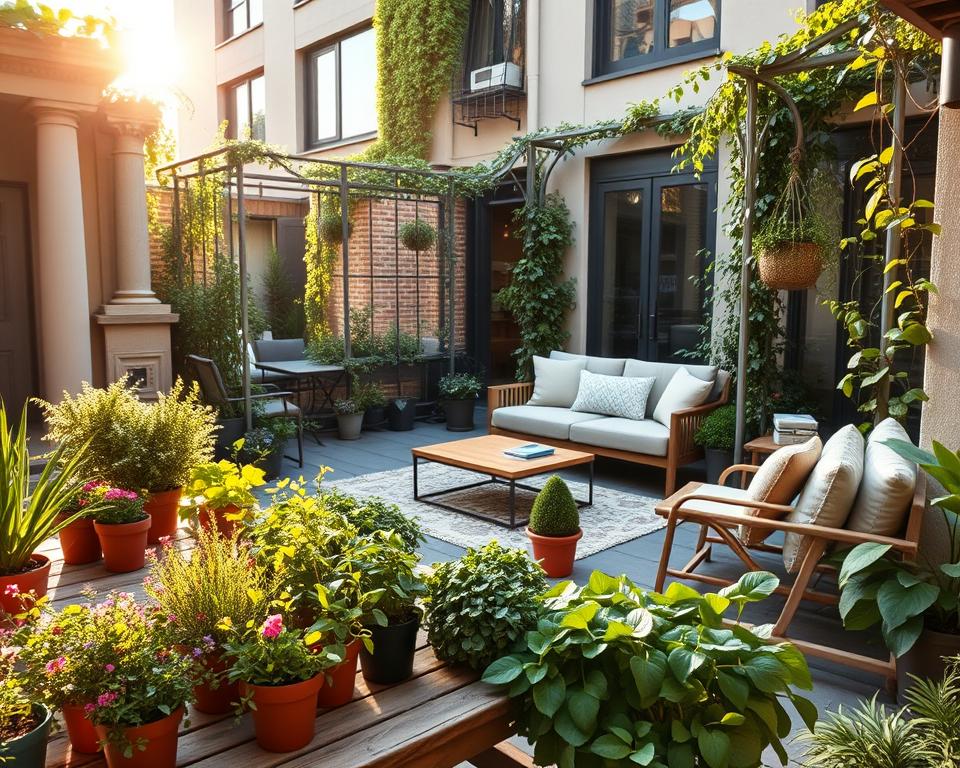
Multifunctional features that save room
Double up elements so each piece earns its place. Raised-bed edges become seating, storage sits under benches and a compact fireplace provides warmth and focus.
Plants with architectural presence
Choose a few sculptural specimens that hold form through the seasons. Use repeated pots and evergreen structure, then add seasonal colour for punctuation.
- Keep circulation simple: clear paths and generous turn points make small gardens feel easy to use.
- Repeat materials: match inside floors to exterior paving for calm continuity.
- Hide clutter: integrated storage and fewer, larger pieces avoid a busy look.
- Include services: lighting, power and water extend daily use beyond summer.
“Treat the plot as a set of rooms and build comfort, not chaos.”
Wildlife-friendly and eco-conscious gardens: planting with purpose
A practical approach supplies food, water and shelter so wildlife can thrive in your plot. You do not need grand changes; simple, well-placed features make the biggest difference over a year.
Think in layers: combine nectar sources, seed and berry plants, water and refuges to support insects, birds and small mammals through the seasons.
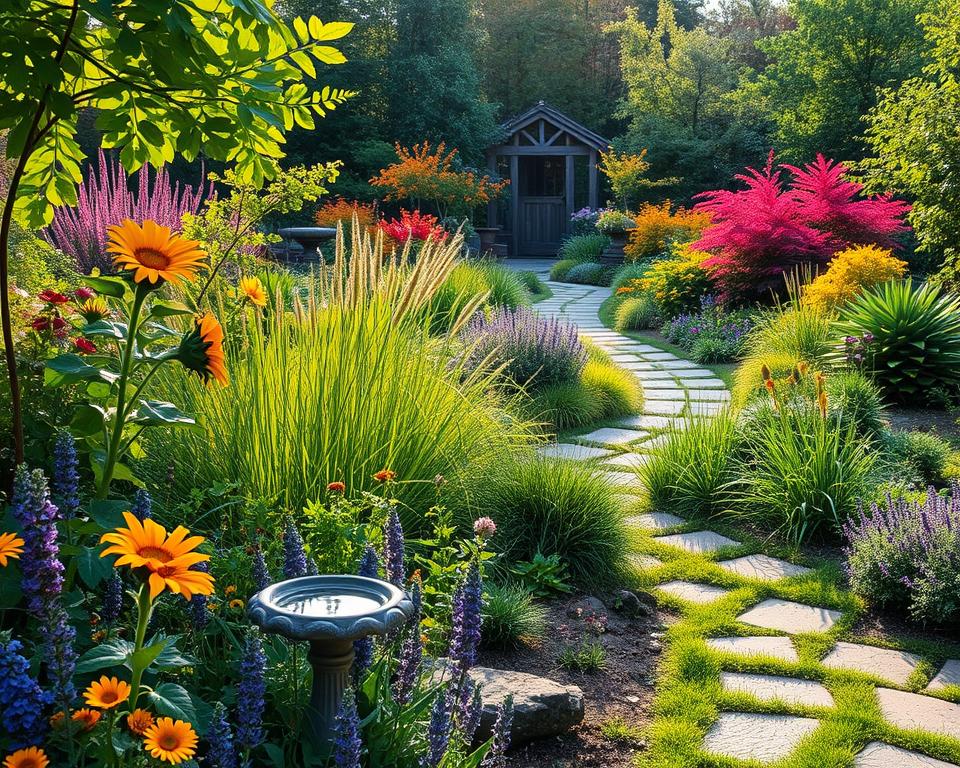
Food, water and shelter: practical features for biodiversity
Provide nectar and pollen by planting for early spring through late autumn. Add seed and berry producers for winter food.
- Add a pond, bowl or rill to supply water for insects, birds and amphibians.
- Build refuges: log piles, hedgehog gaps, bug hotels and correctly sited bird and bat boxes.
- Leave some seedheads and leaf litter through winter before gradual tidying.
Soil health, mulch and low-chemical gardening
Protect soil life by avoiding routine pesticides and feeding soils with an annual mulch of compost or well-rotted manure.
| Practice | Action | Benefit |
|---|---|---|
| Mulching | Spring/top up with compost | Feeds microbes; improves structure |
| Plant choice | Group native and near-native species | Supports local food webs |
| Water | Collect rain; add shallow ponds | Reliable drinking sites; reduces mains use |
| Lighting | Shield fittings; use low level | Protects nocturnal wildlife |
Balance order and wildness with neat edges and wilder cores so neighbours remain pleased and habitats persist.
“Give wildlife food, water and shelter and your small changes build lasting habitat.”
Edible and potager gardens: beautiful productivity
Treat the plot as a room for food and flowers, using ordered beds and clear paths to make work gentle and visible.
Design a crisp grid or parterre with straight paths so you can reach every bed. Keep edges tidy and use high planting densities to shade soil and cut weeds.
Mix herbs, vegetables, shrubs and flowers so pollinators and pest predators find shelter and food. Sow successions to stagger harvests and keep displays continuous.
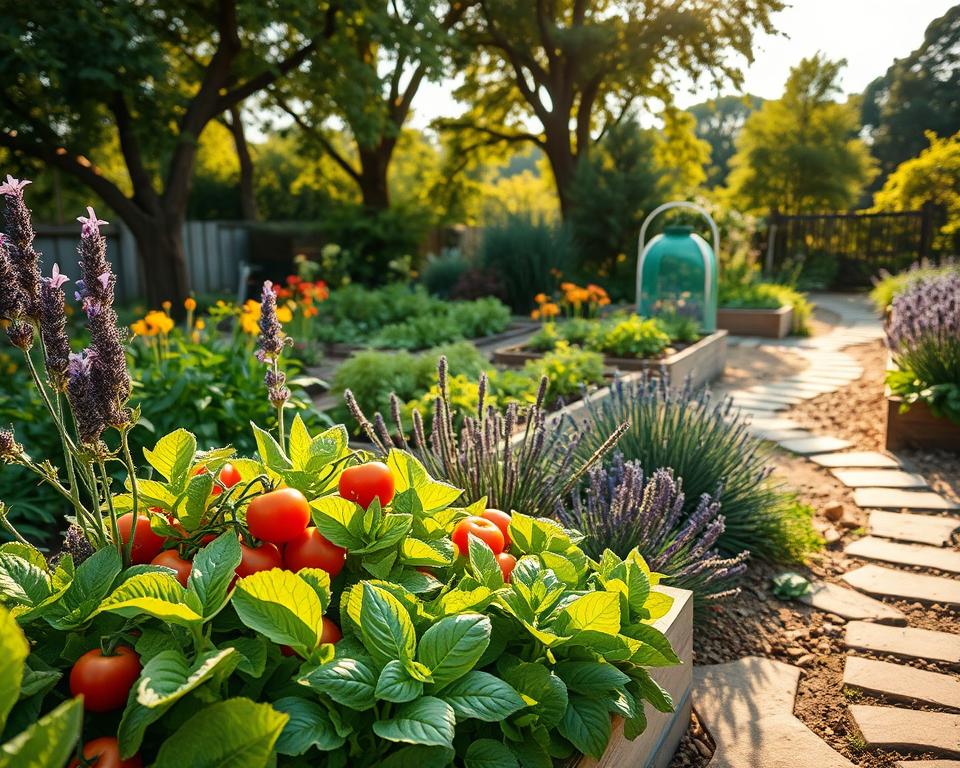
Plan rotations and add green manures to feed soil rather than relying on heavy inputs. Place compost and a water point close to the action to save time and effort.
Choose support pieces—espaliers, obelisks and arches—that lift crops and create rhythm. Add a small seat so you can enjoy the productive view and rest while you tend.
- Tip: combine textures and colour so the potager feels intentional, not allotment-like.
“A potager works best when beauty and bounty follow the same plan.”
Reflecting your home’s architecture and local sense of place
Use architectural cues from your façade to shape paths, hedges and seating that belong to the same place.
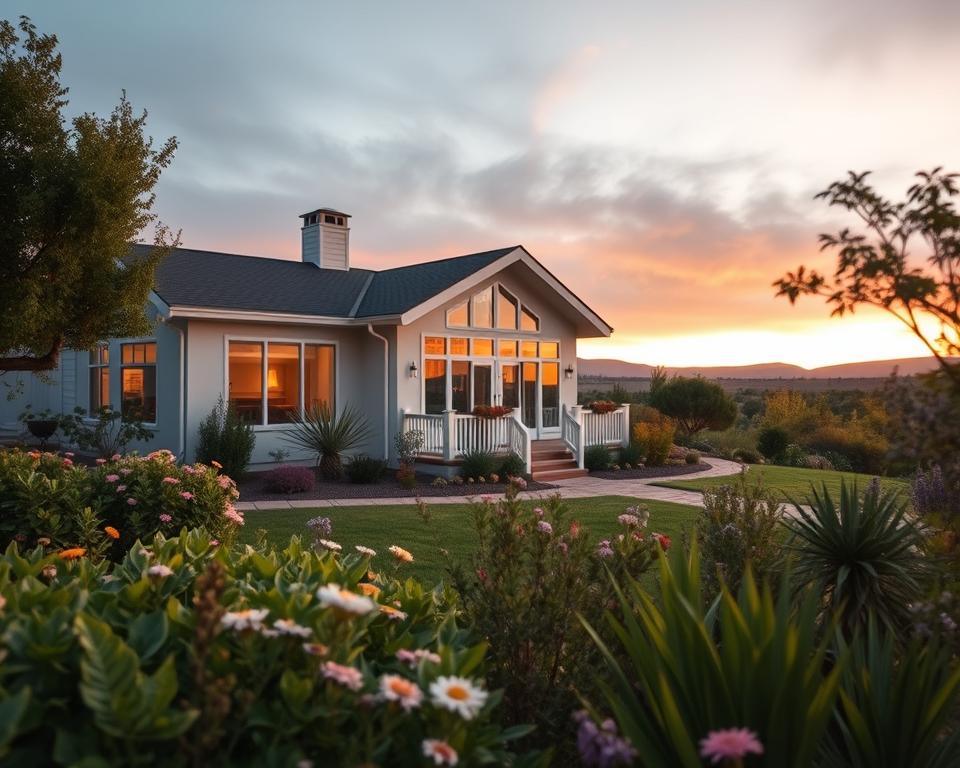
Audit your home’s materials and colours and repeat them outside so thresholds feel seamless. Match brick, stone or joinery tones between inside flooring and the terrace to extend sightlines.
Align path lines and terrace geometry with internal axes so rooms visually continue outdoors. This small move makes access easier and gives a lasting sense of cohesion.
Choose furniture and details that suit the building’s era without pastiche. Use one or two repeated materials — brick, metal or timber — to keep the garden composed.
- Plant hedges and boundary elements that echo local vernaculars for shelter and context.
- Add accents—pots, paint colours—drawn from façade tones to unify movable items.
- Coordinate lighting, drainage and landscaping levels with thresholds for easy flow.
“Let the house be the anchor: edit features so everything reads as part of the same place.”
Conclusion
Wrap up with a simple brief that turns inspiration into action. List your favourite ideas, audit sun and soil, then match maintenance to your available time.
Short steps: shortlist two preferred approaches, pick repeated materials and plants, and build a shopping list for plants and flowers that suit your plot and climate.
Use concise design ideas to guide decisions—borrow calm from a japanese garden, resilience from prairie mixes or the abundance of cottage schemes. Fit contemporary materials (corten, gabions) where they suit the landscape.
Finally, keep the brief live. Edit annually, adapt to seasons, and let practical experience refine your choices as you become one of many confident gardeners.
FAQ
Which broad planting and layout approaches suit small outdoor spaces?
Choose compact evergreen shrubs, architectural perennials and vertical elements such as climbers or trellises to add height without using floor area. Use paving with narrow joints or linear slabs to create the sense of length, and include multifunctional pieces like storage benches or raised beds that double as seating.
How do you match a look to the UK climate and soil?
Start by assessing aspect, wind and soil type. North-facing or shaded sites need shade-tolerant perennials and woodland species; free-draining, sunny spots take drought-resistant Mediterranean herbs and gravel beds. Amend heavy clay with organic matter and consider raised beds for waterlogged areas.
What elements define a traditional formal or English country planting scheme?
Look for structured geometry, clipped hedges or topiary, well-kept lawns and layered herbaceous borders. Focal points like statues, urns or a central tree and restrained colour palettes help achieve the formal mood, while country borders favour abundant, mixed perennials and climbers.
Which materials work best for contemporary designs?
Use restrained, durable finishes such as natural stone, porcelain paving, corten steel for planters and gabion walls. Gravel and resin-bound surfaces give clean lines; choose a limited material palette and repeat it to create cohesion.
How can you create a Mediterranean or dry look in the UK without drying out plants?
Use drought-tolerant Mediterranean species such as lavender, rosemary and santolina in well-drained soils or pots. Incorporate gravel mulches and terracotta pots to warm the aesthetic, but accept partial shade and higher moisture in many UK gardens—select hardy cultivars and improve drainage rather than copying a true Mediterranean climate.
What are the essentials of a cottage planting approach?
Emphasise abundant mixed borders with roses, perennial perennials, climbers and kitchen herbs. Aim for layered planting, informal paths and seating tucked among plants. Limit lawn area and allow a relaxed, slightly untidy look that still considers seasonal repetition and colour balance.
How do gravel or water-wise schemes control weeds and self-seeding?
Start with good soil preparation: remove persistent weeds, lay a permeable membrane if appropriate and add a deep layer of clean gravel. Use drought-tolerant perennials and monitor for seedlings; regular spot weeding early in the season prevents re-establishment.
What makes a Japanese-inspired composition successful in a temperate garden?
Focus on balance, texture and restraint. Use pruned specimen shrubs, carefully placed stones, moss, and open space to create calm. Water features and minimalist planting—often with evergreen accents—reinforce a contemplative mood rather than dense colour.
Which plants suit coastal and wind-exposed locations?
Choose salt-tolerant, wind-hardy species such as maritime grasses, sea thrift, euphorbia and hardy rosemary. Planting into free-draining sand or shingle and using low, sheltering hedges helps reduce wind exposure and protects tender specimens.
How can you introduce exotic, jungle-like layers in the UK climate?
Build layered planting with large-leaved perennials, hardy gunnera or gunnera alternatives, and clumping bamboos in sheltered, moisture-retentive spots. Create microclimates with walls, fences or evergreen screens to retain heat and shelter tender plants.
What planting suits naturalistic or prairie-inspired schemes?
Select tussock-forming grasses and late-flowering perennials such as verbena bonariensis, eryngium and asters. Emphasise movement and seasonal change, plant in drifts for impact, and allow winter structure for year-round interest.
How do woodland or shaded borders stay interesting year-round?
Use layered shade-tolerant plants: spring bulbs and epimediums for early interest, ferns and hellebores for winter and early-spring structure, and shrubs like hydrangea and sarcococca for scent and form. Maintain leaf mulch and rich, well-drained soil.
What are the key points for rock, alpine or mountain beds?
Provide excellent drainage, build rockwork with angular stones and use shallow, gritty soil mixes. Choose compact, hardy alpines and saxifrages suited to exposed, lean conditions and avoid deep organic soils that retain moisture.
When should you create a bog or waterside planting area?
Convert naturally wet hollows or use lined beds to hold moisture. Select plants that thrive in saturated soils—iris, marsh marigold, astilbe and valerian—and design gentle margins to transition into drier planting.
How do you design multifunctional urban courtyards for living and storage?
Plan flexible zones with integrated seating, raised beds that double as storage and vertical greenery to maximise planting. Use durable materials and plants with architectural presence to ensure year-round structure on a small footprint.
What practical steps create a wildlife-friendly, eco-conscious outside area?
Provide food, water and shelter: native flowering plants, log piles, ponds and nesting boxes. Improve soil health with mulch and compost, reduce chemical use and include continuous floral resources from spring to autumn to support pollinators.
Which edible or potager approaches combine beauty with productivity?
Arrange productive beds with ornamental structure—formal beds, pleached fruit trees, herb borders and mixed-cutting beds. Choose dual-purpose plants such as chard, nasturtium and herbs that offer both yield and visual interest.
How do you reflect your home’s architecture and local character in the layout?
Match materials, scale and planting density to the building and street scene. A Victorian terrace suits formal terraces and clipped hedges; a modern house pairs with simple geometry and restrained planting. Use local stone and native species to root the design in place.